天下无双
A star in BRI cooperation_我的网站

一 |
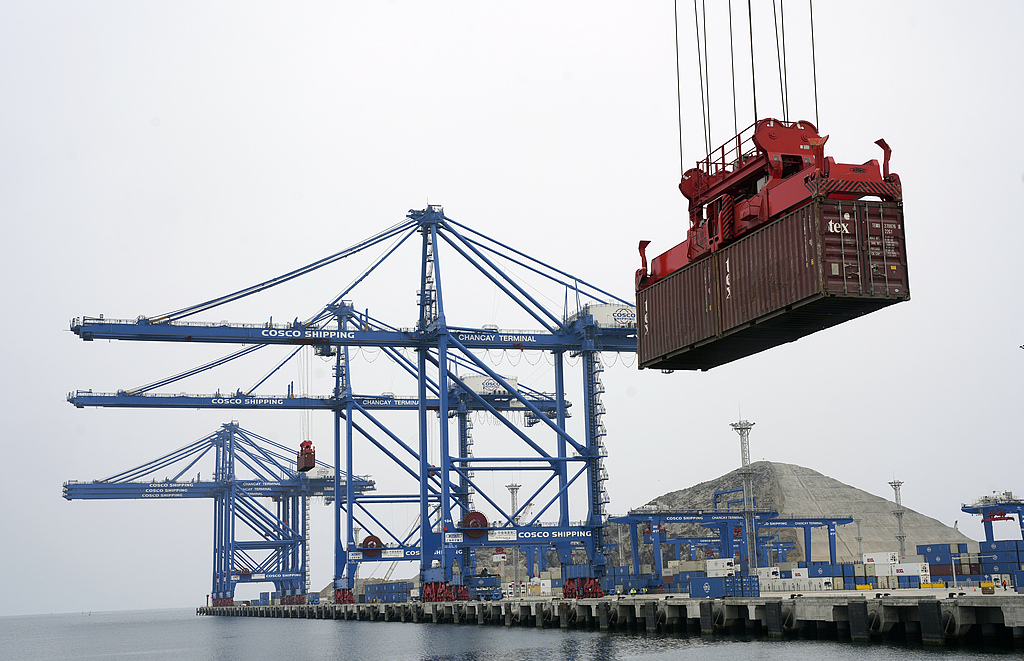
A crane lifts a container at a terminal of the Chancay Port, Peru. File photo: VCG
Nearly two years after its launch, Chancay Port has entered a phase of rapid growth. As an important logistics hub in Peru, the port is accelerating the development of a new Latin America-Asia ocean shipping lane, while intensifying connection and cooperation between many Latin American countries and China.
Recently, China's COSCO Shipping Lines launched the CHX3 (Chancay Express Service 3) feeder service, marking the first regular weekly operation linking Peru's Paita Port, Chancay Port and Costa Rica's Caldera Port.
The new service represents COSCO Shipping's latest effort to expand its presence along South America's west coast, using Chancay Port as a key transshipment hub to support foreign trade channels there. It is one of the latest expansions of COSCO Shipping's regional shipping network.
The launch of CHX3 will further expand Chancay Port's regional reach, providing foreign trade companies in Peru and other Latin American countries with a more stable and efficient logistics route to Asia, Chinese experts said.
As a deep-water port and South America's first smart green port, Chancay Port is a flagship Belt and Road Initiative (BRI) cooperation project between China and Peru. Amid rising unilateralism and geopolitical tensions in the world, the port is playing an increasingly important role in supporting the stability of global supply chains, the experts said.
New shipping routesLocated in northern Peru, Paita Port is a key container and cold-chain hub serving major industrial areas such as Piura and Lambayeque, home to numerous foreign trade companies in agriculture, seafood processing, mining and textiles. The new CHX3 service has improved logistics efficiency, providing exporters with a more efficient logistics channel to China and Asia at large.
The new service, which provides a direct link to Chancay Port and connects with many trans-Pacific ocean routes, will help shorten overall transport time for fresh fruits, reduce cargo loss risks and reduce transportation costs, Peruvian fruit exporter Ecosac said, noting that it will also further expand access for Peruvian fresh fruits to China and other Asian markets.
The role of Chancay Port in expanding China-Latin America shipping network is undergoing significant changes as envisioned, Tang Jie, an expert at the Institute of American and Oceanian Studies at the Chinese Academy of International Trade and Economic Cooperation, told the Global Times on Thursday.
Tang said that the launch of the CHX3 service has connected ports along the west coast of South America and in Central America, significantly reducing transshipment costs and transit time. With its efficient operations, Chancay Port is reshaping the logistics landscape on South America's west coast, boosting trade among regional countries and becoming a "catalyst" for greater economic integration in South America, said Tang.
The impact of Chancay Port on regional connectivity is evident. Since its opening in November 2024, the sea transport time between Peru and China has been shortened to 23 days, cutting logistics costs by 20 percent.
Nearly two years after its inauguration, Chancay Port has generated $3.65 billion in import and export trade, handled 500,000 TEUs of containers, and contributed more than 1.64 billion Peruvian soles in tax revenue to Peru. The port now operates three trans-Pacific trunk routes linking Asia with South America, along with five regional feeder services connecting countries along the continent's western coast.
And, new shipping routes have been launched since earlier this year. On March 31, a direct route linking Taicang Port in East China's Jiangsu Province and Chancay Port opened, cutting transit time to just 26 days. The 7,500-vehicle-capacity LNG dual-fuel vessel Kaiyuan Kou departed Taicang Port carrying Chinese-made EVs and other equipment directly to Chancay Port.
On May 4, a new shipping route between Nanjing Port in Jiangsu and Chancay Port was launched, creating a convenient logistics link between the Yangtze River Economic Belt and the South American market.
In the same month, South China's Guangzhou launched its first direct shipping route to Chancay Port, expanding trade links between Guangdong-Hong Kong-Macao Greater Bay Area and South America.
Zhang Jieyu, assistant research fellow at the Department for Latin American and Caribbean Studies, China Institute of International Studies, told the Global Times on Thursday that the launch of COSCO Shipping's new feeder service and the continued expansion of shipping routes show that the port's role in China-Latin America shipping and trade is undergoing a major shift.
Also, the new shipping routes help improve operational efficiency and ensure stable supplies of key resources such as copper and lithium to China, Zhang said, noting that lower logistics costs support local manufacturing too, assisting Latin American companies to integrate deeply with the global supply chains, in addition to creating many local jobs.
Greater prospectsIn 2025, Chancay handled a total container throughput of 336,200 TEUs, while its bulk cargo and roll-on/roll-off operations reached 1.595 million tons. Currently, the port has launched three trans-Pacific trunk routes, as well as regional feeder services covering multiple countries along South America's western coast.
The port is expected to generate $4.5 billion in annual economic benefits for Peru, contributing 1.8 percent to the country's GDP. The port is also projected to create more than 8,000 jobs, many in logistics and transportation. By boosting local employment and regional economy, Chancay Port becomes a major pillar of Peru's development strategy, the People's Daily reported.
In a previous interview with the Global Times, Ambassador of Peru to China Carlos Vasquez said that "China's efforts to stimulate domestic consumption could create new opportunities for Peruvian exports of healthy and high-quality products."
Under the framework of high-quality BRI cooperation, Chancay Port's expanding shipping network will bring greater certainty to China-Latin America trade. By shortening transit time and improving cargo efficiency, the port will create a more reliable maritime link, providing important trans-Pacific shipping options to strengthen global supply chain resilience, said Zhang.
Chancay Port has significant growth potential. Zhang said that the port can further expand feeder networks along the western coast of South America and Central America, extending connectivity to landlocked Andean countries. Meanwhile, deeper digitalization and AI integration will help turn the port into a model for China-Latin America supply chain cooperation, promoting broader industrial collaboration and supporting regional development.
And, as a green and smart port, Chancay Port's experiences in energy conservation, emissions reduction, automated operations and digital customs are expected to set a benchmark for Latin American ports, said Tang, adding that the port is expected to play an important role in advancing the Green Silk Road and Digital Silk Road initiatives.
。 2026年8月24日,据idrw.org(印度国防研究之翼);综合《The Week》、希腊《Ta Nea》等多家媒体,土耳其媒体试图将印度拖入以色列-土耳其冲突,地区紧张局势升级。 土耳其媒体正越来越频繁地试图将印度与以色列和土耳其之间迅速恶化的战略对抗联系起来。尽管新德里并非以土对抗的一方,但土耳其媒体已将印度描绘为一个更广泛战略联盟的一部分。 以土对抗升级,印度被“拉入战局” 事件的直接背景是以色列与土耳其关系的急剧恶化。2026年8月18日,以色列对叙利亚西北部的阿布·杜胡尔空军基地发动空袭,称此举旨在阻止土耳其在该基地部署军事力量,而安卡拉方面则予以谴责。此后,土耳其媒体开始将印度与以色列、希腊、塞浦路斯和阿联酋联系在一起,暗示安卡拉可能面临一个更广泛的“战略联盟”。 土耳其媒体的“反土三角”论调 这种叙事并非首次出现。2026年1月,土耳其媒体就曾将印度与阿联酋的接触解读为“由以色列、印度、希腊组成的反土耳其恶魔三角”。2026年6月,土耳其国防专家对印度与希腊、塞浦路斯迅速扩大的安全伙伴关系表示担忧,尤其担心希腊和塞浦路斯可能采购印度的布拉莫斯超音速巡航导弹。希腊媒体也描述了“希腊-以色列-印度-阿联酋-塞浦路斯”轴心的出现。

二 | 印度战略自主的底线 然而,报道指出,日益增长的战略关系与正式的“反土联盟”之间存在重要区别。印度与以色列、希腊的防务关系由自身战略利益驱动。印度历来保持战略自主,避免正式绑定军事联盟,其外交政策远比媒体描绘的“简单站队”复杂得多。

三 | 从土耳其角度看,其担忧有战略基础——以色列正阻止土耳其势力在叙利亚扩张。

四 | 但从安卡拉的视角解读印度的独立外交决策,并将其视为反土战略的证据,则过于牵强。印度直接卷入以土军事对抗的动机极其有限。 因此,土耳其媒体将印度置于以土争端报道的核心,更多反映了安卡拉对自身战略环境变化的感知,而非印度的真实意图。返回,查看更多。

五 |
Current article:http://abv.zongchaeiwengshuabaisisuofu.sbs/ctn/uk4cwpk.html
Published on:18:15:21


